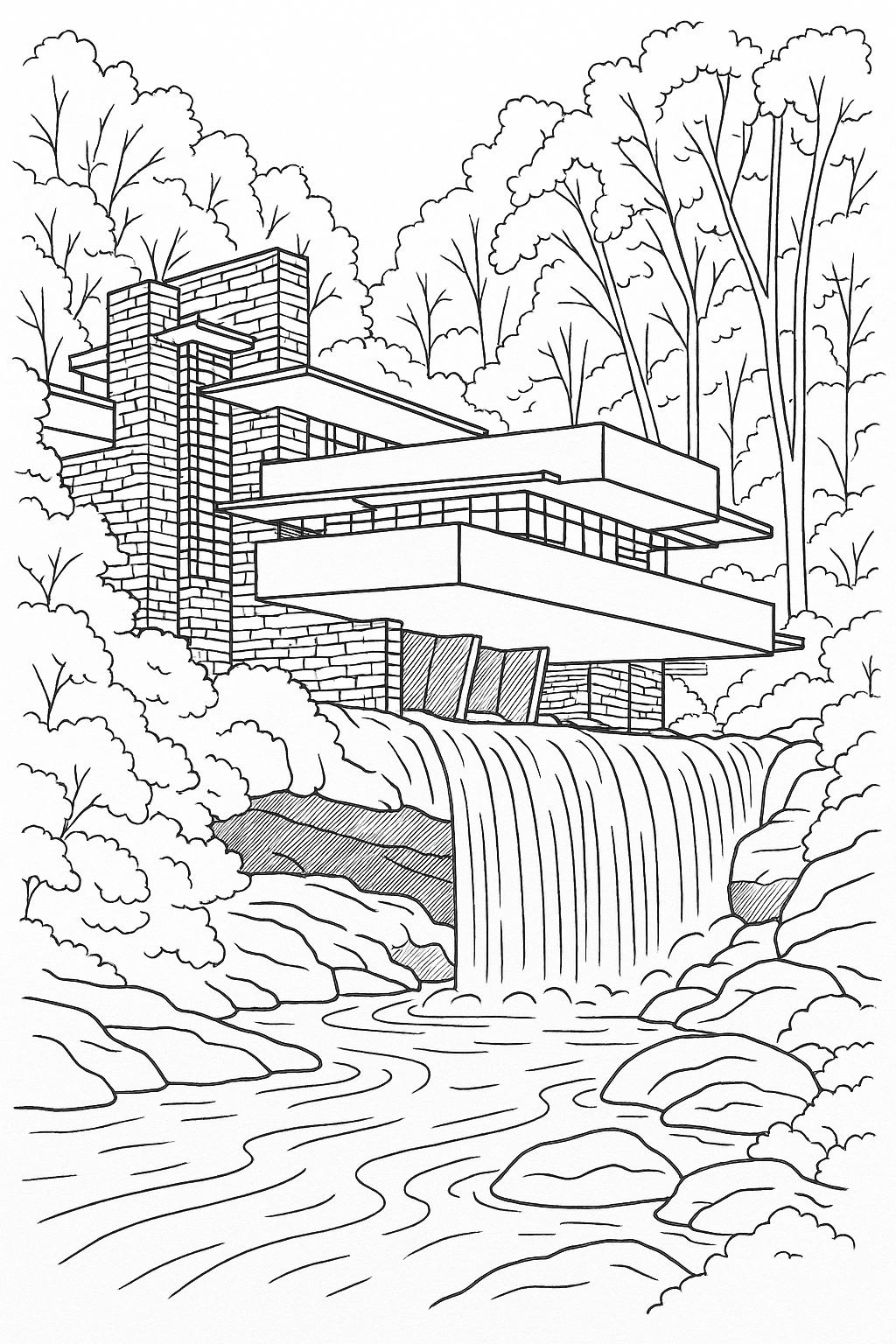
In the rolling woodlands of southwestern Pennsylvania, Frank Lloyd Wright designed a house that seemed to grow out of the very landscape. Completed in 1937 for the Kaufmann family, Fallingwater was conceived not as a retreat overlooking a waterfall but as a structure that lived directly above it. This choice cemented the building’s reputation as a radical statement of organic architecture, a philosophy Wright had been shaping for decades.
The Kaufmanns, Pittsburgh department store owners, wanted a mountain getaway. Wright instead gave them an international landmark, one that blended natural stone, cantilevered terraces, and rushing water into a unified whole.
A Vision of Organic Architecture
Wright’s design philosophy emphasized harmony between human habitation and the natural world. At Fallingwater, he executed this with a daring balance of concrete balconies jutting over Bear Run and local sandstone walls rising from the ground. Large expanses of glass dissolved the boundary between indoors and outdoors, while the sound of cascading water permeated every corner of the home.
The building did not simply sit on the land; it appeared to grow from it. This seamless integration made Fallingwater one of the purest examples of organic architecture ever realized.
The Structure and Its Challenges
The bold cantilevers that define Fallingwater pushed the limits of 1930s engineering. Built primarily of reinforced concrete, stone, and glass, the home required careful consideration of stresses and balance. Over time, the cantilevers began to sag, sparking debate about Wright’s structural choices. In the early 2000s, extensive preservation work was carried out to stabilize the terraces and ensure the home’s survival for future generations.
Despite these challenges, the overall integrity of Wright’s vision remains intact. Today, Fallingwater continues to be admired not only as an artistic creation but also as a technical feat of modernist architecture.
The Interior: A Dialogue With Nature
Inside the home, Wright designed custom furniture and fixtures to echo the horizontal lines of the architecture. Polished stone floors, built-in seating, and narrow stairways lead directly to the stream below. Rooms are oriented to capture specific views of the forest and waterfall, creating a continuous dialogue between the sheltering interior and the expansive outdoors.
Natural light, flowing water, and open space dominate the sensory experience, reminding visitors of Wright’s aim to merge life and landscape into a single harmonious whole.
Cultural Significance and Legacy
Fallingwater quickly became a symbol of American modernism. In 1938, Time magazine featured Wright on its cover, largely due to the impact of this extraordinary house. Over the decades, Fallingwater has been celebrated in exhibitions, books, and films, solidifying its place as one of the greatest achievements in modern architecture.
The house was designated a National Historic Landmark in 1966 and, in 2019, became part of the UNESCO World Heritage list “The 20th-Century Architecture of Frank Lloyd Wright,” alongside seven other Wright designs.
Its influence extends beyond architecture, inspiring designers, artists, and environmental thinkers around the world to reconsider the relationship between human spaces and the natural environment.
Visiting Fallingwater
Today, Fallingwater is operated by the Western Pennsylvania Conservancy and welcomes thousands of visitors each year. Guests can tour the home, walk its wooded trails, and experience firsthand the fusion of art and environment that Wright envisioned. The site remains a pilgrimage for students of design, admirers of modernism, and travelers curious about America’s architectural treasures.

Fallingwater’s enduring appeal lies not only in its striking appearance but also in the way it reshapes how we think about living with the natural world. It is not just a house—it is a manifesto in stone, glass, and water.