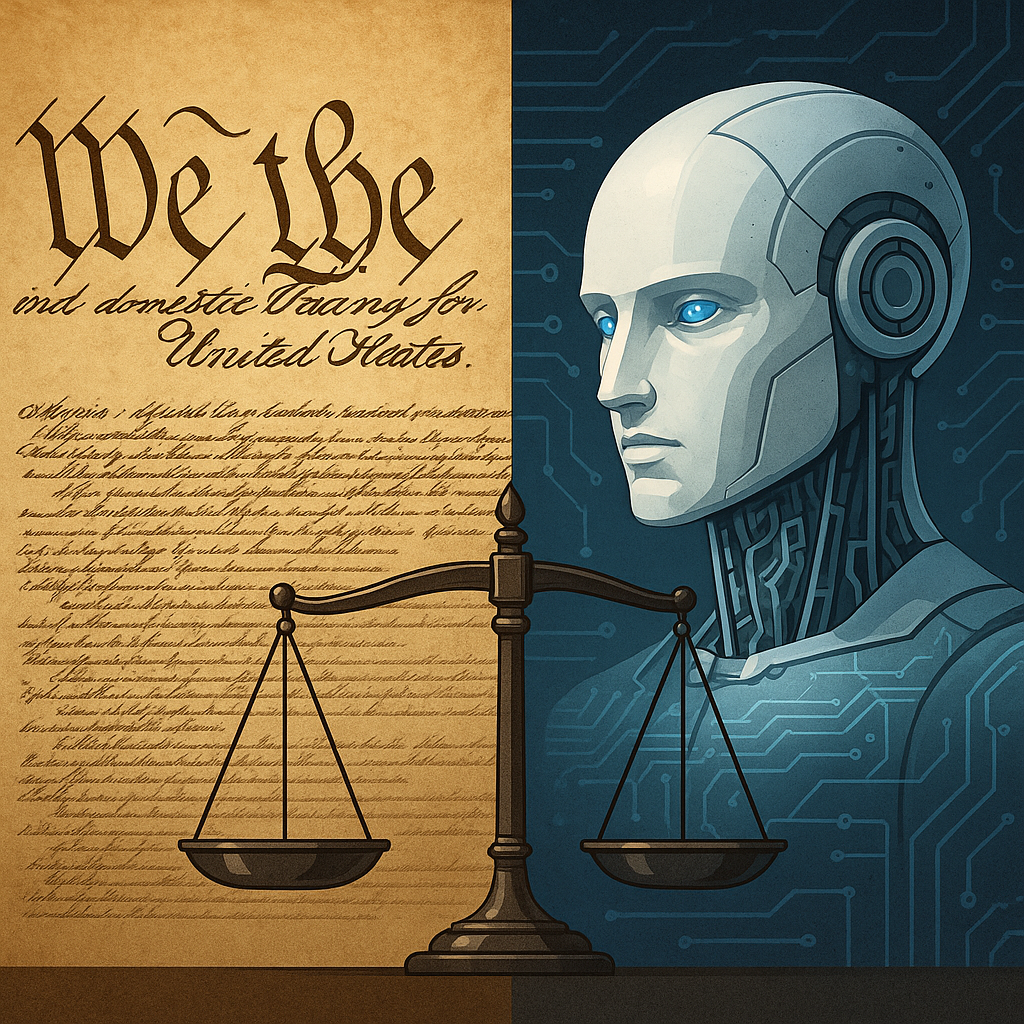
Artificial intelligence has quickly moved from science fiction to daily life. Tools like ChatGPT are now part of classrooms, offices, and households. With this expansion comes a pressing question: does the U.S. Constitution protect AI-generated speech? The Constitution was written to safeguard human expression against government overreach, but corporations, which own and operate AI, also hold certain rights. Whether AI outputs are considered speech or products will define the future of accountability and innovation.
The First Amendment Framework
The First Amendment states: “Congress shall make no law… abridging the freedom of speech.” Courts have repeatedly interpreted this broadly, applying it not just to individuals but also to corporations. Over time, landmark cases shaped how speech is understood. In 1964, New York Times v. Sullivan reinforced strong protections for press freedoms by limiting defamation liability when discussing public figures. In 1976, Virginia State Board of Pharmacy v. Virginia Citizens Consumer Council extended protections to advertising, acknowledging that even commercial messages deserve constitutional shelter. In 2010, Citizens United v. FEC confirmed corporate rights to engage in political spending, reframing corporate speech on a national scale.
These rulings demonstrate a long tradition of expanding what qualifies as protected speech. Yet AI presents a problem. Unlike a journalist or advertiser, it does not hold intent, values, or editorial control. It generates text through algorithms and probability. Whether such outputs count as “speech” is an open legal question.
AI as Speech vs. AI as Product
Advocates for protection argue that AI-generated text reflects human fingerprints. The outputs of ChatGPT or similar systems are shaped by training data, design decisions, and the prompts given by users. Restricting what an AI says could therefore be seen as restricting the expression of its creators. Speech has never required a conscious motive; advertising and commercial statements are protected regardless of why they are made. Supporters of this view also warn of chilling effects: if courts refuse to treat AI outputs as speech, companies may over-censor and innovation could be stifled.
Critics counter with a product-safety framework. AI, they argue, is not a true speaker at all. It lacks authorship, responsibility, or intent. Dangerous or false outputs should be seen as defects, no different from a faulty drug, unsafe car, or mislabeled food product. If a chatbot gives harmful medical advice, instructs someone on how to self-harm, or fabricates damaging claims about a person, shielding the system with First Amendment protections would prevent accountability. In this view, AI is not speech but conduct — the behavior of a product that must be regulated for safety.
Real-World Test Cases
The courts are already being forced to confront these issues. In Raine v. OpenAI, parents allege that ChatGPT contributed to their 16-year-old son’s suicide by providing harmful suggestions and guidance. Their argument frames the chatbot as a defective product that failed to safeguard against foreseeable harm. OpenAI, in defending itself, may invoke First Amendment protections to argue that restricting outputs is equivalent to restricting speech.
Defamation also looms large. AI “hallucinations” that generate false claims about real people could expose companies to libel lawsuits. Traditional publishers can be sued for defamation, but if AI is treated as a defective product rather than a publisher, liability could expand dramatically.
Beyond lawsuits, government regulation is entering the conversation. Lawmakers are proposing rules for age verification, parental controls, and restrictions on AI use in elections, healthcare, or counseling. Whether these regulations survive will depend on whether courts view AI as a form of protected speech or as a technology subject to ordinary consumer-safety rules.
Section 230 and the AI Gap
Another piece of the puzzle is Section 230 of the Communications Decency Act of 1996. This law shields platforms like Facebook or YouTube from liability for content created by users. But AI outputs do not come from users; they are generated by the system itself. If courts conclude that AI responses are company-created content, Section 230 protections would not apply. Without Section 230, companies would likely turn even more heavily to First Amendment arguments to shield themselves from liability.
Corporate Rights and Boundaries
Corporations have historically enjoyed free speech protections, but courts draw distinctions between speech and conduct. Selling defective products is not constitutionally protected conduct, even if it involves words or labels. A drug that fails safety standards cannot be defended as free expression, nor can false advertising. This boundary could define the AI debate. If AI-generated outputs are classified as harmful conduct, companies may find their constitutional arguments weaker.
Possible Outcomes
Courts have several paths forward. One possibility is to grant AI-generated content full speech protection, treating companies much like publishers. In this scenario, liability would be limited and regulation would be more difficult. Another option is a hybrid model where AI outputs are protected in publishing or creative contexts but not in cases involving harm, safety, or defamation. A third outcome is a strict product-liability approach, rejecting speech protections entirely and treating AI as a product subject to regulation, like a drug or automobile.

Artificial intelligence itself is not protected by the Constitution. The protections belong to the people and corporations that build and operate it. The open question is how far courts will extend those protections when AI outputs cause harm. The answer will determine not only the outcomes of current lawsuits but also the future of regulation, innovation, and public trust. As courts begin to weigh these cases, the U.S. legal system stands at the threshold of a constitutional debate as significant as any in the digital age.