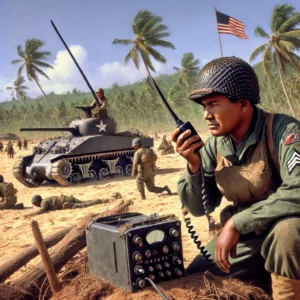
During World War II, in the heat of battle and under immense pressure, a group of Native Americans performed one of the most remarkable feats in military history. Known as the “Code Talkers,” these brave individuals used their native languages, especially Navajo, to create an unbreakable code that helped secure victory in the Pacific Theater. Their contributions remained a secret for decades, but today, their legacy is widely recognized as one of the most crucial elements of U.S. military strategy during the war.
The Origins of Code Talking
The concept of using Native American languages in military communication began during World War I when Choctaw soldiers serving in France transmitted secure messages that German forces could not decipher. This early success laid the groundwork for what would become a sophisticated system during World War II.
In 1942, the U.S. Marine Corps began recruiting Navajo speakers to develop a code based on their language. Navajo was an unwritten language with complex grammar and phonetics that made it an ideal candidate for secure communications. The first group of 29 Navajo Code Talkers created the foundation of the code, developing a vocabulary for military terms that didn’t exist in Navajo, such as planes, ships, and weapons. They substituted words from their own language to represent these items—”turtle” meant tank, and “iron fish” referred to submarines.
Unbreakable Code
The Navajo language, combined with the innovation of the Code Talkers, created a code that baffled Japanese forces throughout the war. The complexity of the language, with its varied tones and structures, made it impossible to decipher. Unlike many other military codes that could be cracked through pattern recognition, the Navajo code offered no such clues. This level of security gave the U.S. military a tremendous advantage.
One of the most famous examples of the Code Talkers’ success came during the Battle of Iwo Jima, where six Navajo Code Talkers worked tirelessly, transmitting over 800 messages without error. Their communication speed and accuracy played a critical role in the U.S. victory in this bloody and decisive battle.
Other Tribes’ Contributions
Although the Navajo are the most well-known group of Code Talkers, they were not the only Native Americans to serve in this capacity. Comanche Code Talkers were used by the U.S. Army during the Normandy invasion in Europe, and Hopi Code Talkers served in the Pacific. Each tribe brought its own language and ingenuity to the effort, providing diverse contributions to the war.
Recognition and Honors
For many years after the war, the work of the Code Talkers remained classified. It wasn’t until the late 1960s that the full scope of their contributions was declassified. Even then, it took decades for their story to receive widespread recognition. In 2000, the U.S. Congress passed the Code Talkers Recognition Act, honoring these brave men with Congressional Gold and Silver Medals.
The Navajo Code Talkers’ legacy continues to be celebrated today, with memorials, museums, and films telling their incredible story. In 2001, a film titled Windtalkers brought their story to the big screen, further highlighting their crucial role in World War II.
The Importance of Language in Warfare
The story of the Code Talkers underscores the power of language as a tool of warfare. In a time when encryption technology was limited, human ingenuity and cultural uniqueness provided a solution that technology could not. The Navajo language, spoken by fewer than 200,000 people worldwide, became one of the most powerful weapons the U.S. had in its arsenal.
Beyond their military contributions, the Code Talkers have become symbols of the often-overlooked contributions of Native Americans to U.S. history. Their story is one of resilience, courage, and an enduring connection to their cultural heritage.

The Navajo Code Talkers and their counterparts from other Native American tribes played a vital role in securing victory for the United States during World War II. Their unbreakable code saved countless lives and helped turn the tide in key battles like Iwo Jima. Today, the Code Talkers are rightly celebrated as heroes, not only for their bravery in the field but for the unique way in which their cultural identity became a cornerstone of military success. Their legacy continues to inspire future generations, reminding us of the power of language, culture, and the human spirit in the face of adversity.