In 1888, Edward Bellamy, a relatively unknown journalist and novelist from Massachusetts, published Looking Backward: 2000–1887. At first glance, it seemed like just another work of speculative fiction. Yet within a few years, Bellamy’s vision of a future society had become one of the most influential books of its time. It went through dozens of printings, inspired clubs across the United States, and gave rise to a political movement that carried his name: Bellamyism.
Why did this work of utopian science fiction capture the public’s imagination so strongly? To answer that, we must look not only at the story Bellamy told, but also at the turbulent social climate of the late 19th century.
A Journey into the Year 2000
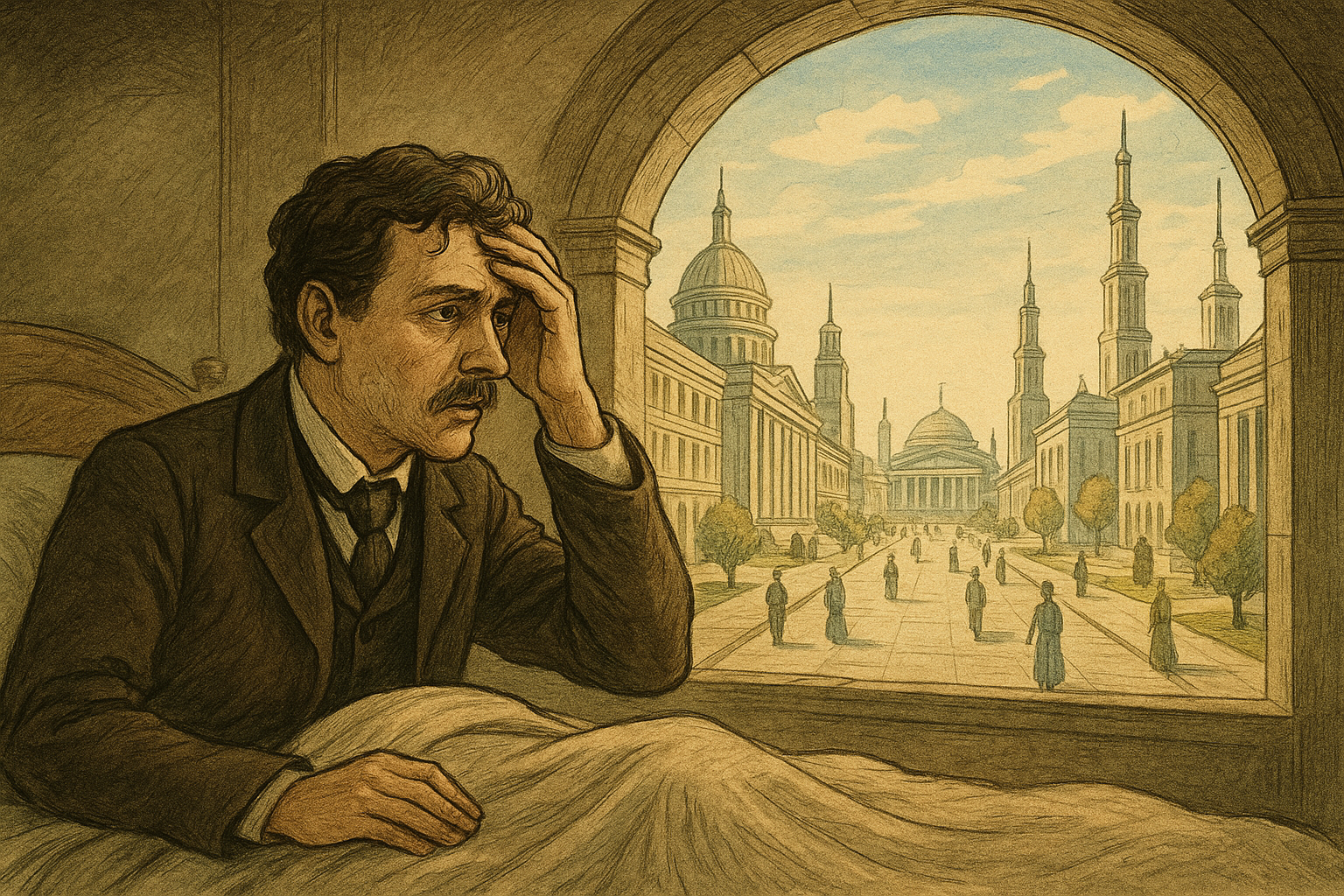
The novel’s protagonist, Julian West, is a wealthy Bostonian living in 1887. Struggling with insomnia, he seeks rest in a special underground chamber and, through an unusual turn of events, falls into a deep sleep that lasts over a century. When he awakens in the year 2000, he discovers a transformed America: a society without poverty, crime, or corruption.
In Bellamy’s imagined world, the economy has been nationalized. Industry is organized into a single great trust controlled by the people, eliminating competition and the inequalities it bred. Citizens receive equal education, access to goods, and guaranteed security from cradle to grave. Work is assigned fairly, hours are reasonable, and everyone receives a share of society’s prosperity.
This was not just a flight of fancy. It was Bellamy’s response to the widening gap between rich and poor in the Gilded Age, when monopolies, labor strikes, and poverty were daily realities. For readers struggling with these issues, Bellamy’s utopia was both a critique of their present and a hopeful vision of the future.
Striking a Chord in the Gilded Age
By the late 1880s, the United States was experiencing rapid industrialization. While fortunes were being made, millions of workers lived in harsh conditions: long hours, unsafe factories, and little pay. The gap between wealthy industrialists and ordinary laborers was becoming too wide to ignore.
Bellamy’s novel offered an alternative—an egalitarian system that promised stability and fairness. To many, it seemed not just idealistic but attainable. Unlike Thomas More’s Utopia or other fictional societies, Bellamy’s world was rooted in technological and economic trends his readers could already see emerging.
The Rise of the Bellamy Clubs
The book became a publishing phenomenon. Within two years, more than 200,000 copies were sold, making it one of the best-selling books of the 19th century. Readers did not stop at discussing the story; they organized themselves into “Nationalist Clubs,” dedicated to spreading Bellamy’s ideas of cooperative economics and social reform.
These clubs, numbering in the hundreds at their peak, attracted reform-minded citizens, intellectuals, and activists. They published pamphlets, hosted lectures, and even entered politics. The Nationalist magazine, launched in 1889, gave a platform to writers and thinkers who wanted to turn Bellamy’s fictional vision into real policy proposals.
Though these organizations did not form a long-lasting political party, they directly influenced the growth of the Progressive movement in the early 20th century and helped inspire debates about labor rights, public ownership, and social welfare.
Critics and Legacy
Not everyone embraced Bellamy’s vision. Critics accused him of promoting socialism, an ideology many Americans feared at the time. Others dismissed his imagined future as too simplistic or authoritarian, with too much reliance on centralized control. Still, the book forced conversations about inequality and the role of government in society—debates that continue to resonate today.
Bellamy himself wrote a sequel, Equality (1897), to expand upon his ideas. While it did not reach the same level of success, the influence of Looking Backward endured. Reformers from labor leaders to socialists to progressive politicians cited it as an inspiration.
Even today, scholars consider it one of the most important works of American utopian literature. Its questions about fairness, economic justice, and the responsibilities of a modern society still echo in discussions of universal basic income, automation, and public welfare.
Why It Created a Movement
The impact of Looking Backward came not just from its ideas, but from its timing. Bellamy published his work during a period when Americans were searching for answers to social and economic instability. His vision was bold but also relatable, grounded in the promise that technology and organization could build a more humane society.
Unlike abstract political theory, Bellamy wrapped his philosophy in a compelling story of personal discovery. Readers could see themselves in Julian West’s shoes, awakening to a future where injustice had been overcome. The novel was not only read but acted upon, proving that fiction can be a catalyst for real-world change.

Looking Backward: 2000–1887 was more than a novel. It was a spark that ignited a nationwide movement, inspired thousands of readers to organize, and planted seeds that would influence American politics for decades. Edward Bellamy, through a story of time travel and utopia, gave a generation a framework for imagining a better world—and a reason to try to build it.