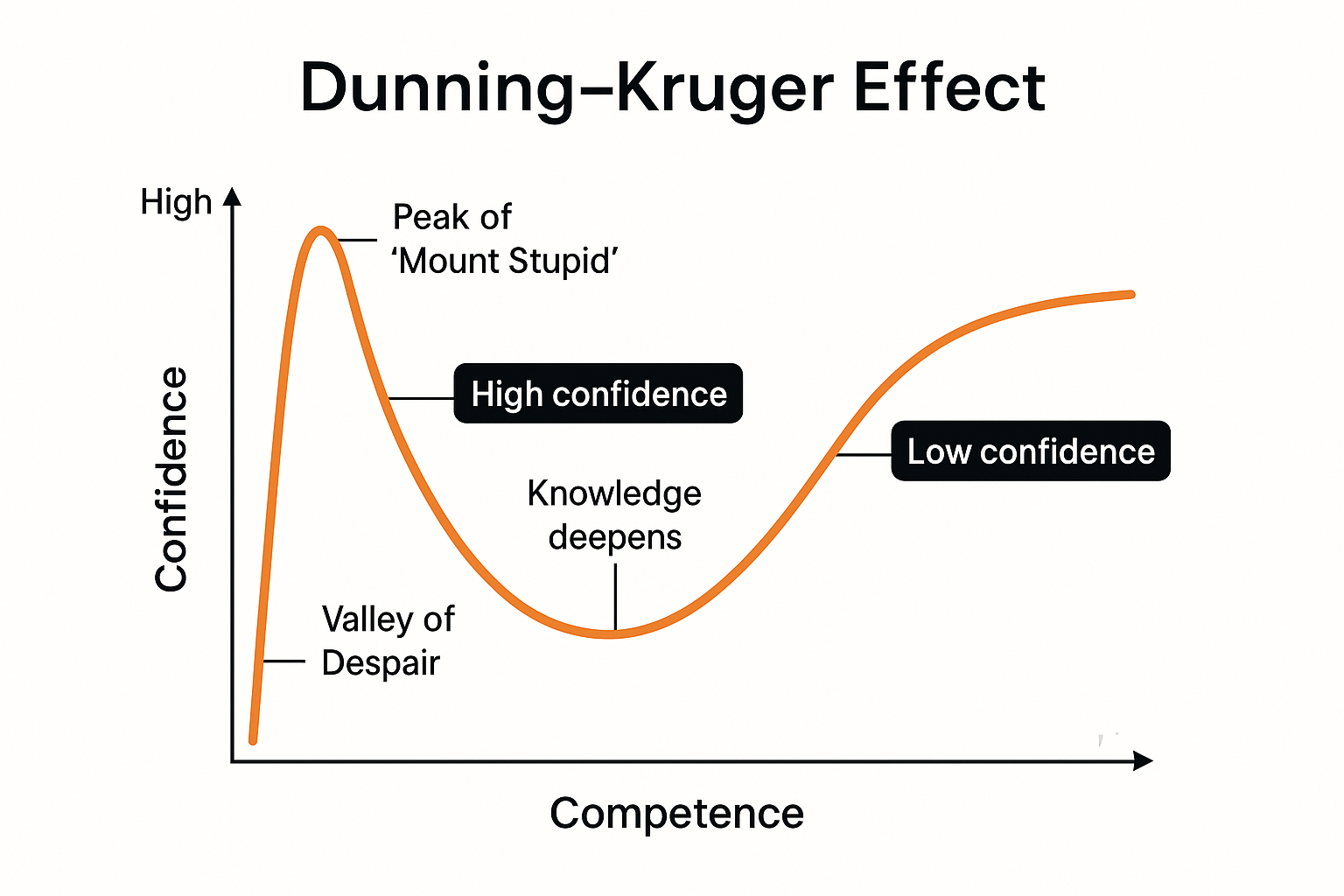
The human mind is prone to curious biases, and one of the most striking is the Dunning–Kruger effect. It describes the gap between how competent people actually are and how competent they believe themselves to be. Put simply: those with the least knowledge often feel the most confident, while those with the most expertise tend to underestimate themselves.
Where It Began
Psychologists David Dunning and Justin Kruger first identified this effect in a 1999 study. They found that individuals who performed poorly on tasks involving grammar, logic, and humor consistently overestimated their performance. In contrast, highly skilled individuals often assumed others found the tasks just as easy, leading them to underestimate their relative ability.
Their work revealed a paradox: ignorance not only causes mistakes but also robs people of the ability to recognize those mistakes.
How the Effect Unfolds
- The Peak of Overconfidence
Beginners may feel invincible after learning a few basics. With little awareness of complexity, they overestimate their skills. - The Valley of Despair
As knowledge deepens, reality sets in. Learners realize how vast the subject is, and confidence drops sharply. - Climbing Toward Mastery
With continued learning, competence grows. Confidence begins to rise again—but this time, it is tempered with humility.
Examples in Daily Life
- Workplace: A new employee might assume they’ve mastered a role within weeks, while seasoned professionals understand the subtleties that take years to grasp.
- Education: Students may stop studying too soon, convinced they “already know enough.”
- Public Discourse: The loudest voices in debates about politics, science, or health are often those with the least expertise, while true experts tend to speak cautiously.
Why It Matters
The Dunning–Kruger effect influences personal growth, education, and society at large:
- In learning: Overconfidence can prevent improvement.
- In leadership: Poor self-awareness can lead to misguided decisions.
- In society: When misinformation spreads, confident but unskilled voices often drown out cautious experts.
Recognizing this bias is the first step toward more accurate self-evaluation.
Avoiding the Trap
- Ask for feedback: Others can see your blind spots more clearly than you.
- Stay humble: Remember that every subject is deeper than it seems at first glance.
- Measure with evidence: Rely on results, not just feelings of confidence.
- Keep learning: Expertise is built over time, not overnight.

The Dunning–Kruger effect is a reminder that confidence and competence are not always aligned. Beginners often feel too certain, while experts carry doubts born of true understanding. By staying curious, open to feedback, and humble in our learning, we can navigate this cognitive bias and move closer to genuine mastery.