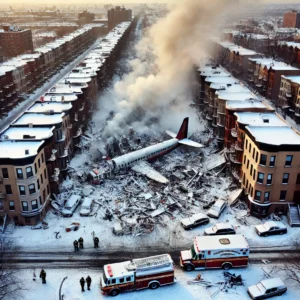
On December 16, 1960, New York City witnessed one of the most devastating air disasters in U.S. history: the mid-air collision of United Airlines Flight 826 and TWA Flight 266. This tragic event occurred over the skies of Staten Island and Brooklyn, killing 134 people, including passengers, crew, and individuals on the ground. The catastrophe not only shocked the nation but also led to crucial reforms in air traffic control and aviation safety. This article delves into the details of the collision, its aftermath, and the lasting legacy it left on both aviation and the communities affected.
The Aircraft and the Collision
On that fateful day, two commercial flights were headed toward New York City:
- United Airlines Flight 826, a Douglas DC-8 jetliner en route from Chicago to Idlewild Airport (now JFK International Airport), carrying 84 people.
- TWA Flight 266, a Lockheed Super Constellation propeller aircraft with 44 passengers and crew aboard, flying from Dayton, Ohio, to LaGuardia Airport.
Due to inclement weather, including heavy clouds and snow, both flights were operating under instrument flight rules (IFR), relying on air traffic controllers and cockpit instruments to navigate. However, the United Airlines DC-8 encountered a failure in its navigation equipment. The aircraft veered off course and was flying at an incorrect altitude, setting it on a collision path with the TWA flight.
At approximately 10:33 a.m., disaster struck. The two planes collided mid-air at around 5,000 feet over Staten Island. The right wing of the United Airlines DC-8 sheared off the top of the TWA Super Constellation, causing both aircraft to break apart. Debris from TWA Flight 266 fell over Staten Island, while the damaged DC-8, still partially intact, continued flying for several more miles before it plummeted into the Park Slope neighborhood of Brooklyn.
The Crash in Park Slope
The destruction caused by the collision was catastrophic. United Airlines Flight 826 crashed into the densely populated streets of Park Slope, Brooklyn, near the intersection of Seventh Avenue and Sterling Place. The wreckage set multiple buildings ablaze, including a church and an apartment complex. Residents in the area were caught in the chaos, with six individuals on the ground losing their lives in addition to the passengers and crew on board both planes.
The streets of Park Slope became a scene of devastation, with burning wreckage, destroyed homes, and emergency crews working to extinguish fires and rescue survivors. In the midst of this devastation, a remarkable discovery was made: 11-year-old Stephen Baltz, a passenger on the United Airlines flight, was pulled alive from the wreckage. Despite the heroic efforts to save him, he succumbed to his injuries the following day, becoming the last victim of the disaster.
Aftermath and Impact
The 1960 New York mid-air collision was the deadliest aviation disaster in the United States at the time, claiming the lives of 128 passengers and crew members, as well as six civilians on the ground. The event shook the nation, leading to a public outcry for improvements in aviation safety and air traffic control procedures.
Investigations into the disaster revealed several contributing factors, including the navigational error made by the United Airlines DC-8 and deficiencies in the air traffic control system. The accident highlighted the need for better coordination between pilots and controllers, especially in busy airspace like that surrounding New York City. As a result, significant reforms were implemented in the years following the collision, including enhanced radar systems, improved communication protocols, and stricter altitude separation rules.
Legacy
While the 1960 mid-air collision was a deeply tragic event, it also played a pivotal role in shaping modern aviation safety standards. The reforms introduced in the wake of the disaster have since made air travel significantly safer, preventing similar tragedies from occurring in the years that followed.
In the Park Slope neighborhood, the memory of the crash remains ingrained in the community. A memorial plaque was installed in the area to honor the victims, serving as a poignant reminder of the lives lost and the profound impact the disaster had on New York City.

The 1960 New York mid-air collision stands as one of the most tragic events in aviation history, marking a somber day for both the families of the victims and the communities affected. Yet, in the aftermath of this devastating event, important lessons were learned that transformed aviation safety. As we remember the lives lost, it is also essential to recognize the lasting legacy of this disaster, which ultimately contributed to making air travel safer for future generations.