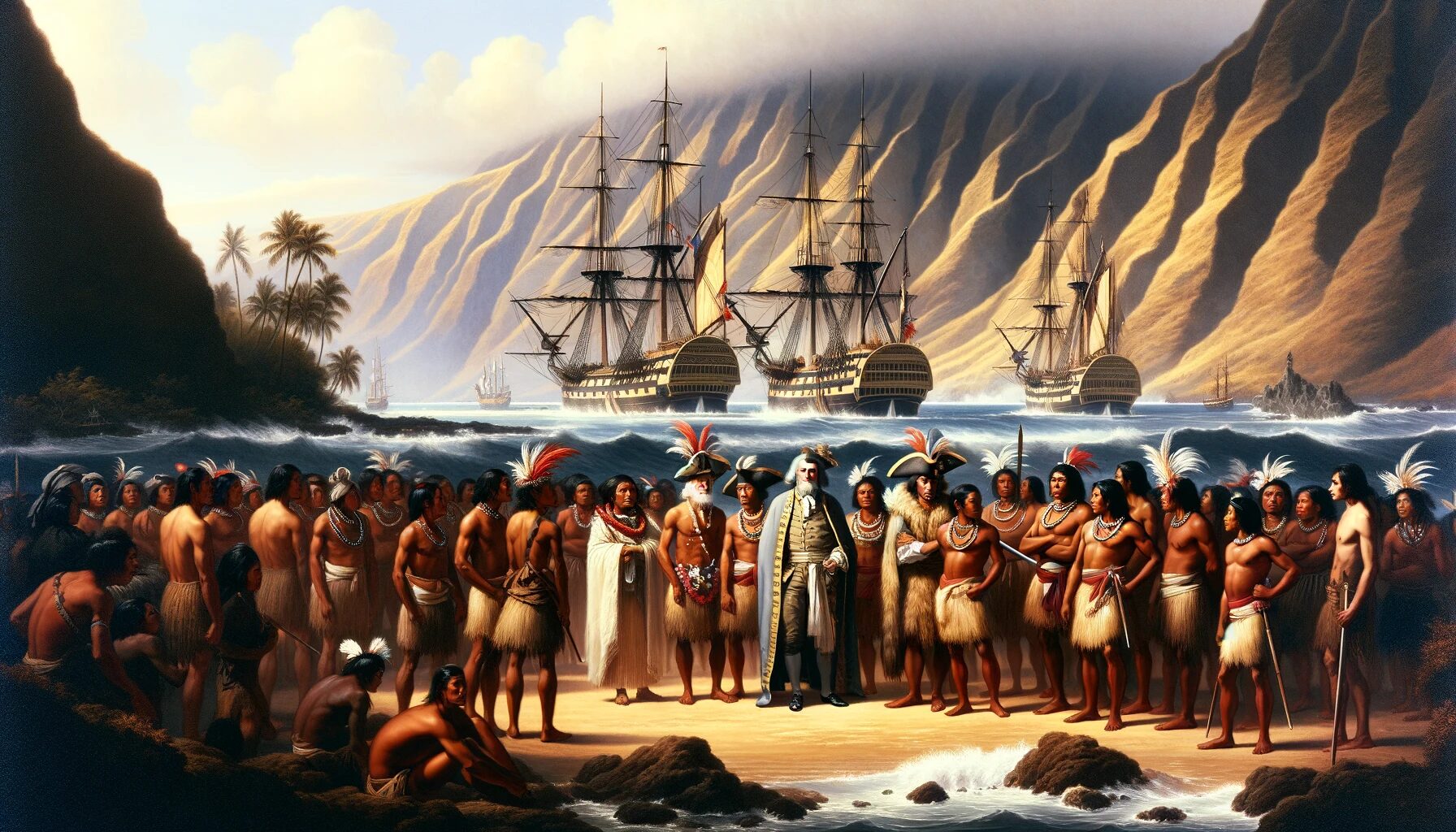
The death of Captain James Cook on February 14, 1779, in Hawaii, is a story often told from a Eurocentric viewpoint, emphasizing the tragic end of a great explorer. However, to understand the full scope of this historical event, it is crucial to explore the Hawaiian perspective, which sheds light on cultural misunderstandings and the impact of foreign intrusion on indigenous societies.
Initial Encounters with Cook
When Captain Cook arrived in Hawaii in 1778, during his third Pacific voyage, his timing coincided with the Hawaiian Makahiki festival, dedicated to the god Lono. The Hawaiians initially perceived Cook and his crew as being associated with their gods, partly due to the resemblance of their ships to certain symbols in Hawaiian mythology. This led to the Hawaiians welcoming the strangers with honor and reverence, a gesture deeply rooted in their spiritual and cultural practices.

Changing Perceptions
The relationship between Cook’s crew and the Hawaiians was initially one of mutual curiosity and respect. However, as time passed, the strain on resources and the continuous presence of the Europeans led to growing tensions. The Hawaiians, accustomed to visitors leaving their shores after a short stay, began to see the prolonged presence of Cook and his men as a violation of their norms and hospitality.
The Turning Point
The situation deteriorated when Cook’s ships returned to Hawaii for repairs after initially leaving, breaking the cultural protocol of the Makahiki season. This unexpected return was seen as an ill omen by the Hawaiians. The breaking point came when a group of Hawaiians took one of Cook’s small boats, leading to a severe escalation of tensions.
The Fatal Confrontation
In an attempt to regain control, Cook planned to take Kalaniʻōpuʻu, the high chief of Hawaii, hostage. This act was a grave miscalculation, deeply offending the Hawaiians and challenging their sovereignty. The resulting confrontation, fueled by cultural misunderstandings and the Hawaiians’ defense of their dignity and leadership, led to Cook’s death. From the Hawaiian viewpoint, this was not a mere act of violence but a defense of their land, culture, and leaders against what they perceived as an overstepping of boundaries by the foreigners.
Reflection and Legacy
For Hawaiians, the death of Cook marked a significant moment in their history, signifying the complexities of early encounters with Europeans. It underscores the impact of foreign intrusion on indigenous cultures and the inevitable clash when cultural norms and values are misunderstood or disregarded. Cook’s death, from the Hawaiian perspective, is a story of resistance against foreign dominance and a poignant reminder of the need for mutual respect in cross-cultural interactions.

The Hawaiian narrative of Captain Cook’s demise provides a critical counterpoint to the traditional Eurocentric accounts. It highlights the importance of understanding historical events from multiple perspectives, particularly those of indigenous peoples whose voices have often been marginalized. This perspective not only enriches our understanding of the past but also offers valuable lessons in cultural sensitivity and the complexities of human interactions in a global context.
A seventh-generation descendent of King Kamehameha personally told me the legendary story of how Captain Cook died from the native viewpoint: James Cook was revered as god-like on his first encounter on the islands because of his ships, tools, knowledge and seemingly friendly nature; however, when he returned it was obvious that he had encountered trials and tribulations on his journey and his demeanor changed. He attempted to land his ships in Kealakekua which is considered sacred as a burial ground for the indigenous leaders–a heiau (pronounced hay-yowl). Warriors were called upon to defend the shores of the bay but Cook was haughty and ignored their pleas to land elsewhere. Skirmishes resulted. Respect was damaged. Neither party would compromise so the warriors killed him. Yes, they mutilated his body according to their customs. Because Cook was once thought upon as god-like, the leaders of the warriors cut out his heart and ate it so that his knowledge would pass onto them. The heiau remains in it’s original location and is marked. Ms. Kelihihananui took me there and we swam in the crystal waters, an area now known as the “City of Refuge”. You can see Captain Cook’s memorial marker about a mile on the curve to the right of the burial ground. The indigenous people of Hawai’i do not revere James Cook yet they understand exploration and progress although they are not happy with the commercialism that evolved in their native land.
Thank you for this telling. I’ve always been curious as to what the descendants of those there during Cook’s time felt of the situation.