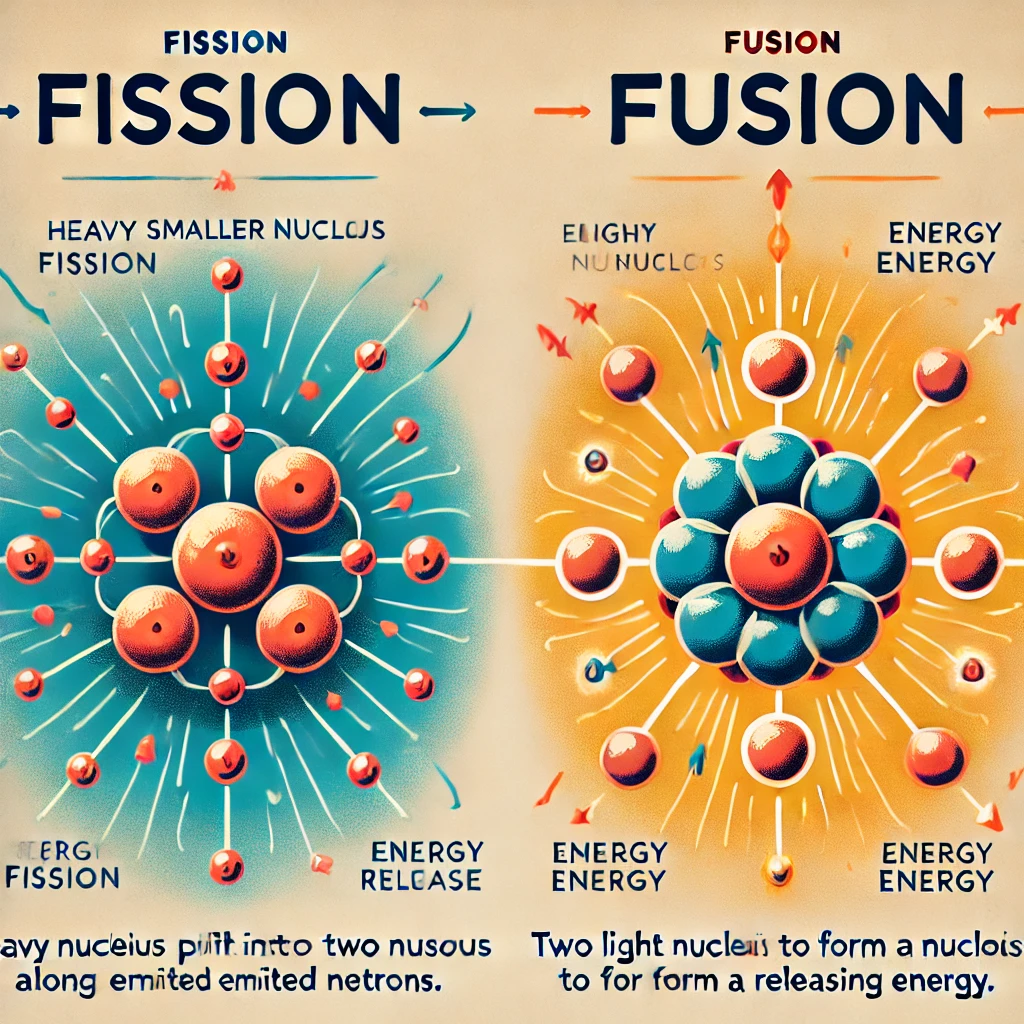
Nuclear energy has long been a topic of fascination and debate. At its core are two fundamental processes: fission and fusion. Both processes release energy, but they operate in distinct ways and have different implications for energy production and safety. This article delves into the differences between these two nuclear reactions, their applications, and their potential for the future.
What is Fission?
Definition
Fission is a nuclear reaction in which the nucleus of an atom splits into two or more smaller nuclei, along with a few neutrons and a large amount of energy. This process is typically induced by bombarding the nucleus with a neutron.
Mechanism
- Initiation: A heavy nucleus (such as uranium-235 or plutonium-239) absorbs a neutron.
- Nucleus Splitting: The absorbed neutron makes the nucleus unstable, causing it to split into two smaller nuclei.
- Release of Neutrons and Energy: The splitting process releases additional neutrons and a significant amount of energy in the form of gamma rays and kinetic energy of the fragments.
Applications
- Nuclear Power Plants: Fission is the primary reaction used in nuclear reactors to produce electricity. The heat generated from fission is used to produce steam, which drives turbines to generate electricity.
- Nuclear Weapons: Fission is also the reaction behind atomic bombs, where uncontrolled fission reactions lead to massive explosions.
Advantages and Disadvantages
- Advantages:
- High energy yield.
- Reliable and continuous power supply.
- Disadvantages:
- Radioactive waste disposal.
- Risk of nuclear accidents.
- Limited fuel supply (uranium and plutonium).
What is Fusion?
Definition
Fusion is a nuclear reaction in which two light atomic nuclei combine to form a heavier nucleus, releasing energy in the process. This reaction powers the sun and other stars.
Mechanism
- Initiation: Two light nuclei (such as isotopes of hydrogen, deuterium, and tritium) come close enough to overcome their electrostatic repulsion.
- Nuclei Combining: At extremely high temperatures and pressures, the nuclei fuse to form a heavier nucleus (such as helium).
- Release of Energy: The fusion process releases a tremendous amount of energy, primarily in the form of light and heat.
Applications
- Experimental Fusion Reactors: Scientists are working on creating sustainable fusion reactions for energy production. Projects like ITER (International Thermonuclear Experimental Reactor) aim to achieve this.
- Potential for Clean Energy: Fusion promises an almost limitless supply of clean energy if it can be harnessed effectively.
Advantages and Disadvantages
- Advantages:
- Abundant fuel supply (hydrogen isotopes).
- Produces minimal radioactive waste.
- Inherent safety (no risk of runaway reactions).
- Disadvantages:
- Requires extremely high temperatures and pressures.
- Technological and engineering challenges.
- Currently not a commercially viable energy source.
Key Differences Between Fission and Fusion
Fuel
- Fission: Uses heavy elements like uranium-235 and plutonium-239.
- Fusion: Uses light elements like hydrogen isotopes (deuterium and tritium).
Energy Output
- Fission: Releases energy by splitting heavy nuclei.
- Fusion: Releases energy by combining light nuclei.
Byproducts
- Fission: Produces radioactive waste that needs long-term management.
- Fusion: Produces minimal radioactive waste, mainly helium, which is non-toxic.
Safety
- Fission: Risk of nuclear meltdown and radiation leaks.
- Fusion: Safer due to no risk of runaway reactions and limited radioactive byproducts.
Technological Status
- Fission: Well-established technology with commercial reactors in operation.
- Fusion: Still in experimental stages, with significant research and development needed.

Both fission and fusion hold immense potential for energy production, but they operate on fundamentally different principles. Fission, with its established technology, provides a significant portion of the world’s energy but comes with challenges related to safety and waste disposal. Fusion, on the other hand, offers a promise of cleaner and virtually limitless energy but requires breakthroughs in technology and engineering to become viable. Understanding these differences is crucial as we explore sustainable and safe energy solutions for the future.